
SACRAMETS
Far from being empty rituals or boxes to check off, the Sacraments are how God desires to give Himself to us, to pour His life into our souls, and to sustain us during our earthly pilgrimage. Jesus instituted each of the seven Sacraments and entrusted them to the Church so that He could remain with us always. Each Sacrament is an encounter with the real and living God. To learn more about the Sacraments, see the Catechism of the Catholic Church, beginning in paragraph number 1210.
Baptism
"Whoever believes and is baptized will be saved, but whoever does not believe will be condemned."
-Mark 16:16
The Sacrament of Baptism marks the beginning of the Christian life and is the gateway to all other Sacraments. Through Baptism, God cleanses the soul of original sin, adopts a person as His beloved son or beloved daughter, and begins to dwell in the soul by grace. The Church encourages parents to baptize children as soon as possible because the graces of the Sacrament are real and effective.

Reconciliation/Confession
“If we confess our sins, he is faithful and just and will forgive us our sins and purify us from all unrighteousness.”
- 1 John 1:9
The Sacrament of Reconciliation is the Sacrament of God’s mercy. God always desires to forgive our sins and to draw us back to His Heart, but He will not force His love upon us. He waits for us in the Sacrament of Reconciliation. Jesus gave the apostles His authority to forgive sins, and this same authority has been passed on through the centuries to bishops and priests (Jn. 20:23). Therefore, when we confess our sins to a priest with true contrition and a desire to do penance, we receive absolution (forgiveness) of our sins from the priest by the power of Jesus Christ.

The Holy Eucharist
"This is my body, which is given for you; do this in remembrance of me".
- Luke 22:19
At every single Holy Mass, by the power of the Holy Spirit, normal bread and wine are transformed into the true Body, Blood, Soul, and Divinity of Jesus Christ. Though the Eucharist still looks like normal bread and normal wine, the reality is that it is truly God Himself. The mystery of the Eucharist should never cease to amaze us. The same God who created the universe and all that is within it chooses to humble Himself in the Eucharist just to be with us. Because the Eucharist is truly Jesus, one must be a practicing Catholic in a state of grace (no mortal sins on one’s soul) in order to receive Holy Communion. If a Catholic is not in a state of grace, Jesus waits for that person in the Sacrament of Reconciliation so that He can pour out His mercy.

Confirmation
"And do not grieve the Holy Spirit of God, with whom you were sealed for the day of redemption."
- Ephesians 4:30
Confirmation completes and perfects the graces received in Baptism. It is one of the three Sacraments of Christian Initiation (Baptism, Confirmation, the Eucharist) that incorporates a person into the Body of Christ. By receiving the Sacrament of Confirmation, the baptized Christian is sealed with the gifts of the Holy Spirit and strengthened to be a true witness of Christ.
The Diocese of Pensacola-Tallahassee is transitioning to a “restored order” of the Sacraments of Initiation, which means that reception of Confirmation will precede reception of First Holy Communion. Since reception of the Eucharist marks the fullness of initiation as a Catholic, it is only fitting for Confirmation to be received first. At St. Rita, this practically means that children around the age of seven (after proper Sacramental preparation) will receive the Sacraments of Confirmation and First Holy Communion at the same Mass.

Holy Matrimony
“Therefore a man shall leave his father and his mother and hold fast to his wife, and they shall become one flesh”
- Genesis 2:24
Holy Matrimony is a lifelong covenant established between a man and a woman that is ordered to the good of the spouses and the procreation and education of children. The Sacrament of Matrimony is meant to be a reflection of the love of Christ for the Church–a love that is free, total, faithful, and fruitful. In a sacramental Marriage, God gives spouses the graces necessary to love each other with His own love, and thereby to make them holy. Christian spouses ought to see it as their God-given duty to help their spouse and children get to Heaven.

Holy Orders
"This is my body, which is given for you; do this in remembrance of me".
- Luke 22:19
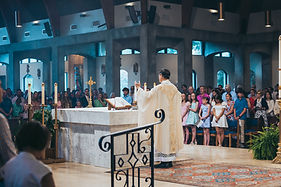
Holy Orders is the Sacrament through which the mission entrusted by Christ to his apostles continues to be exercised in the Church until the end of time” (Catechism of the Catholic Church paragraph 1536). Since Jesus chose twelve men to be his apostles, the Church makes clear that only a baptized man can receive the Sacrament of Holy Orders. This Sacrament has three distinct degrees, namely: deacon, priest, and bishop. The reception of this Sacrament is ordered to the salvation of souls, and thus, priests, deacons, and bishops are called to lay down their lives for the sake of the Church.
Anointing of the Sick
"Is any among you sick? Let him call for the elders of the church, and let them pray over him, anointing him with oil in the name of the Lord;"
- James 5:14
“The Sacrament of Anointing of the Sick has as its purpose the conferral of a special grace on the Christian experiencing the difficulties inherent in the condition of grave illness or old age” (Catechism of the Catholic Church paragraph 1527). This Sacrament can be received more than once, namely, each time a Christian falls seriously ill or when the illness progresses. Through this Sacrament, Jesus unites the sick person more closely to Himself, imparts courage to endure suffering, forgives sins, restores physical health if it is good for salvation of a person’s soul, and prepares a dying person for death.
